Have you ever picked corn in the morning, shucked it that afternoon, and eaten it for supper that evening? If you were born after 1920, the answer is probably “no”. That’s the date of the first U.S. census that indicated over 50% of Americans were “urban” versus “rural”.
Aw, shucks. You don’t know what you’re missing. We rural folk may not have easy access to 5-star restaurants with world-renowned chefs, but trust me, that doesn’t mean we don’t eat well.
Imagine this: It’s early spring, and the sun is barely visible above the horizon as I step out my back door on my way to the barn for morning chores. I happen to glance at my asparagus patch as I pass by and Lo, and Behold! Three shoots have sprung up overnight, the first of the season. Now, that is not nearly enough for a meal for Danny and me. I could pick them and store them in the refrigerator until the crop produces enough shoots for a meal, but that might still be several days away and these three spears would lose some of their just-picked yumminess.
So, I make an executive decision. I snap the spears, shake off the dew, and eat them raw right then and there. You know that eyes-closed look on the face of a chocoholic taking the first bite of a designer-made truffle? That’s the look on my face as I take my first bite of my first spear of the season.
I do feel a twinge of guilt for not saving them and sharing with Danny, but that quickly disappears with my second bite.
That “just-picked yumminess” is the reason why I no longer purchase asparagus from a supermarket. Or cucumbers. Or beets. Or basil. Or dill.
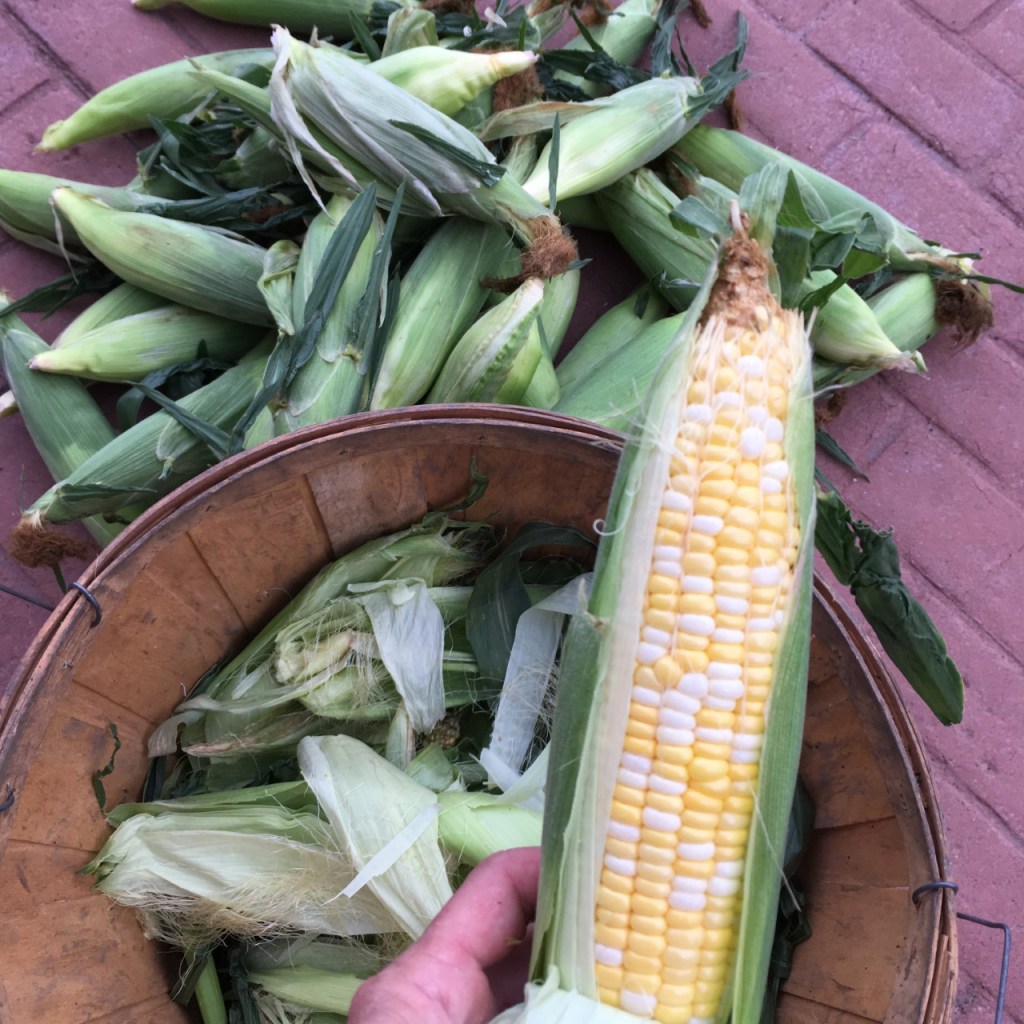
Or corn. I have been spoiled. Now, don’t get me wrong. “Fresh” corn from a supermarket is good, but once you’ve tasted corn the same day it was picked, you just can’t go back.
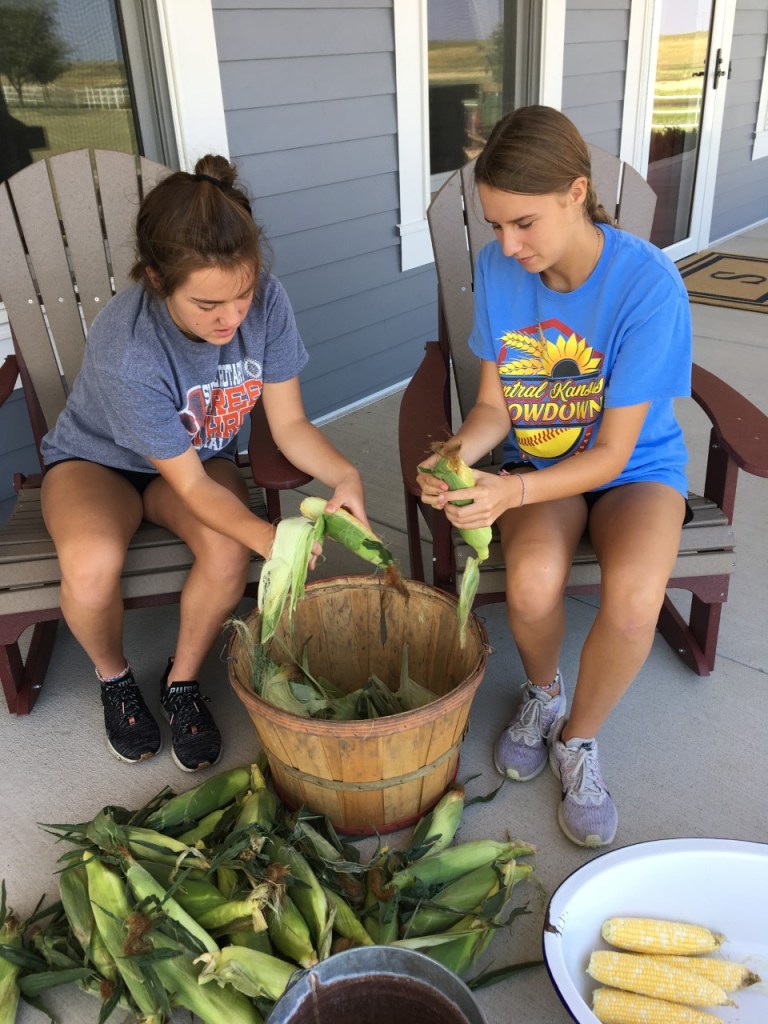
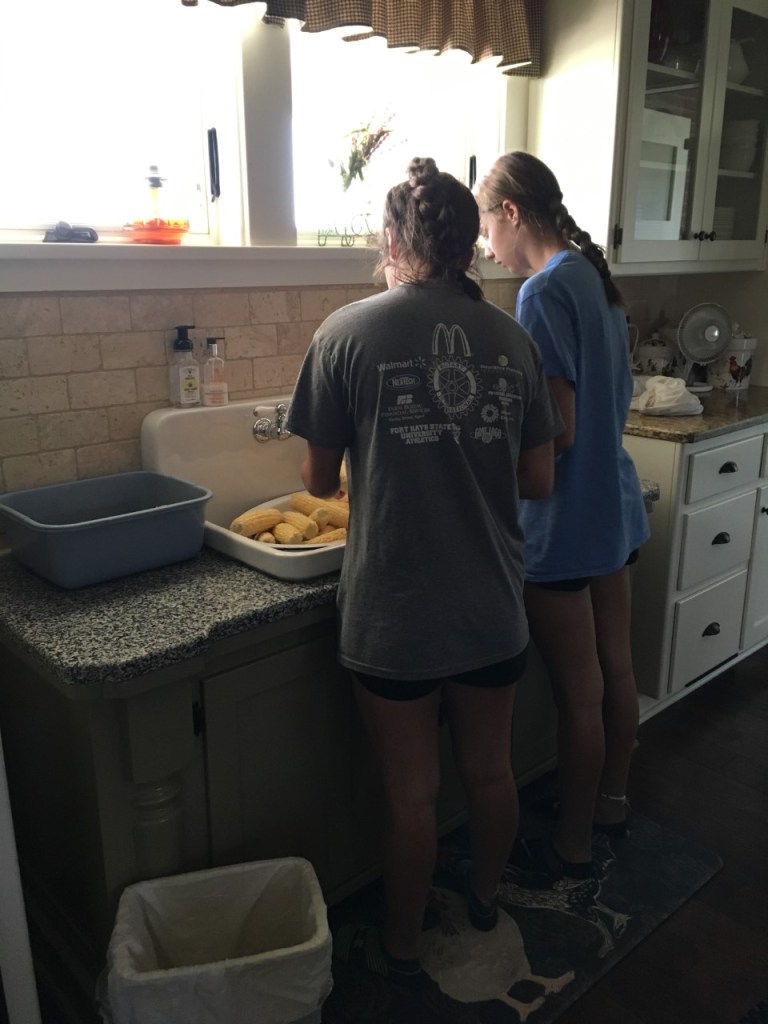
A couple of weeks ago, one of my great-nieces visited our farm with her friend. They just happened to be here during our annual sweet corn harvest. They helped us clean and preserve the corn, and in return, we gave them just-picked sweet corn to eat for supper. They thought it was a very fair trade.
They helped shuck:
And they helped wash and preserve:
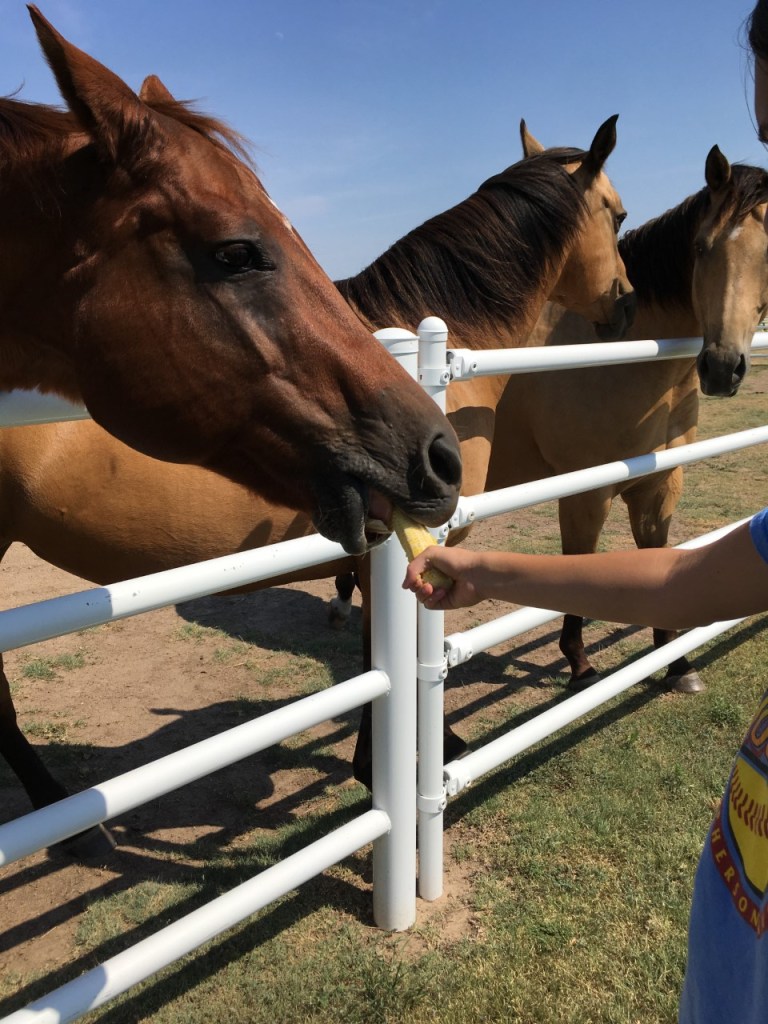
Even the horses enjoyed the leftovers!
Every spring as I prepare my garden for another season, I ask myself: Is it worth it?
Is the fresh produce worth all the hours spent in my garden and in front of the kitchen sink and a hot stove? Is it worth the muddy knees and sore back muscles?
And every spring the answer is the same. Yes. Definitely, yes.
And this year I was happy to see them. Well, maybe that is a bit too strong of a statement. Let’s just say that I was not unhappy to see them. Because, rest assured, there have been many years in the past when I was unhappy. Very unhappy. Let me explain.
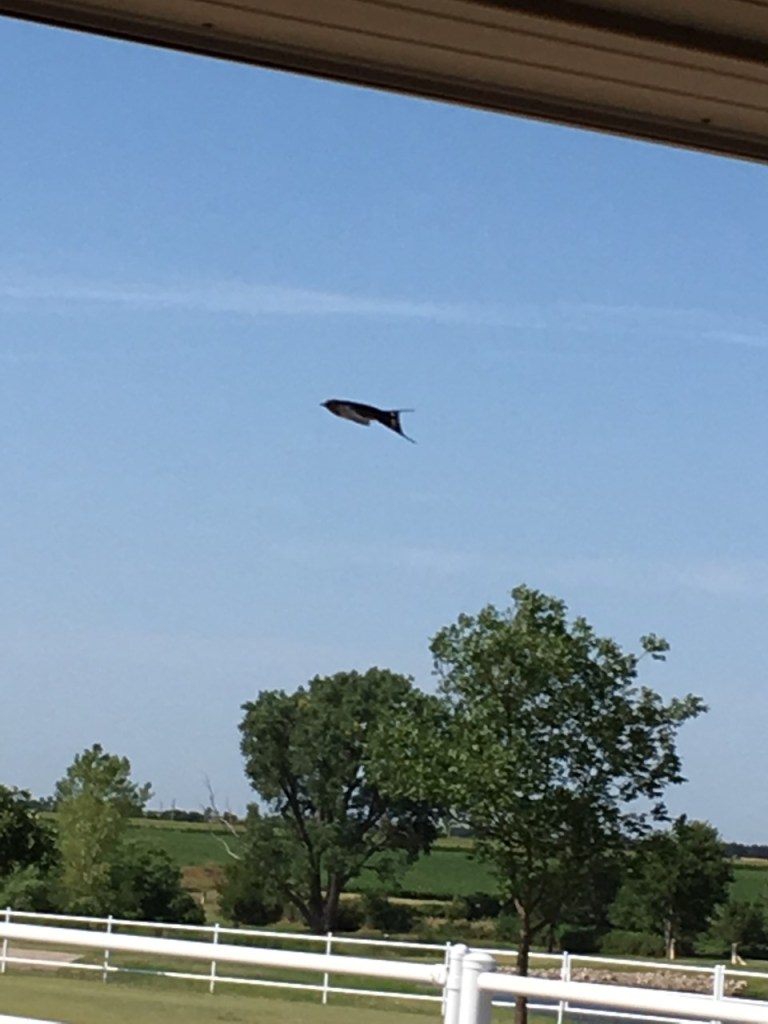
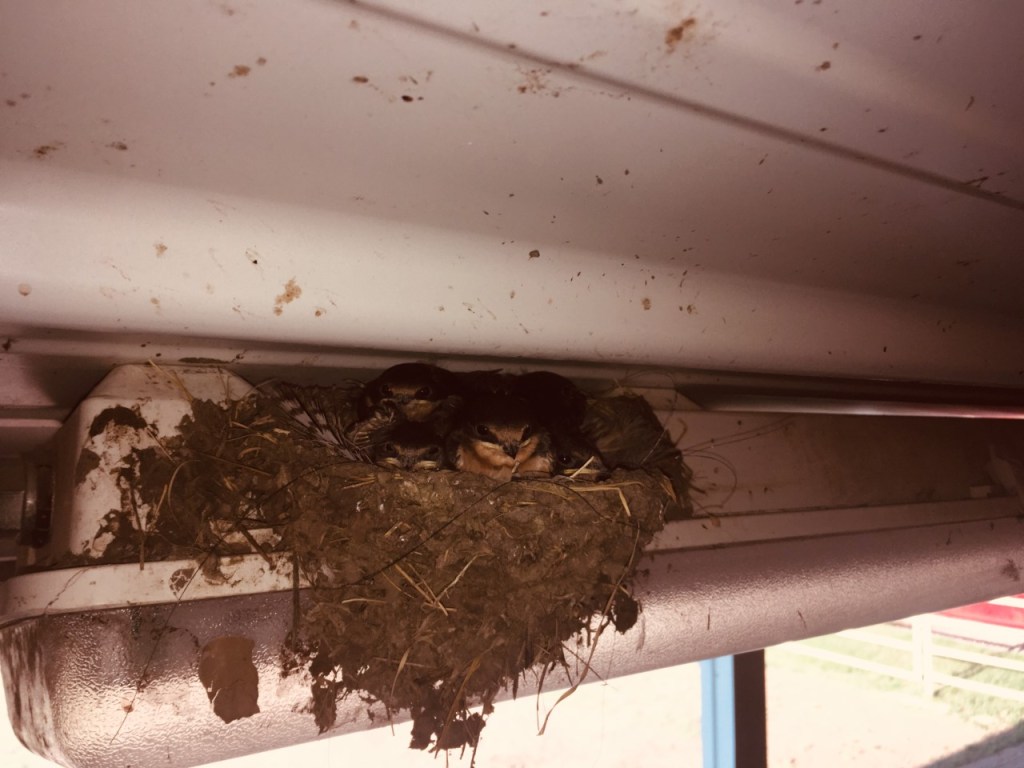
Masterful engineers, barn swallows build mud nests that cling to ceilings or, as in our case, the fluorescent light fixture on the ceiling of our barn. When we first built our barn twelve years ago, the swallows selected what they considered an ideal spot inside one of the stalls. But swallows can be aggressive when protecting their nest. They squawk and swoop towards your head as a warning to stay away. Plus, they poop on the floor. And the hay bales. And the horse waterer. And the…you get the idea.
So, on a daily basis, I would knock down the mud nest before they had a chance to lay any eggs. I was persistent and determined that they not soil my new horse stalls. Unfortunately, they were just as persistent and determined to raise their babies in their “ideal spot”.
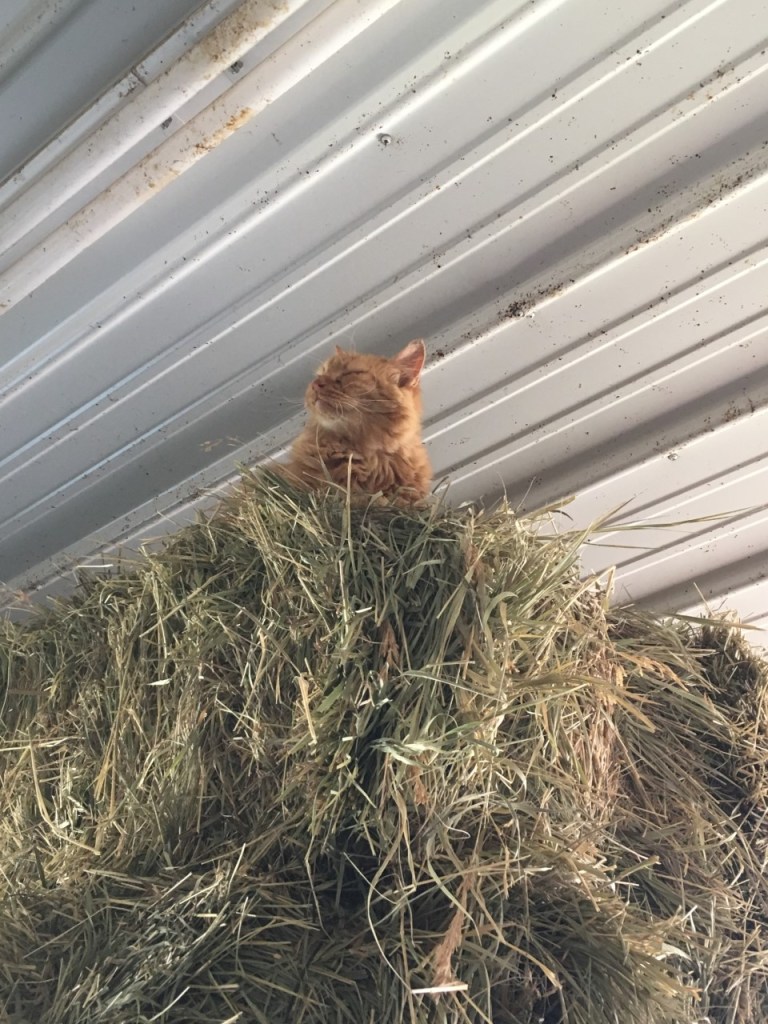
It was finally Simba, perched on our newly-stacked hay bales mere inches from their nesting site, who would convince the swallows that the spot they had selected was, perhaps, not as ideal as they first imagined. They would finally give up and go elsewhere.
After several years of this same routine – me knocking down each day’s progress on their mud nest until the hay bales were stacked and Simba claimed his own “ideal spot” – the swallows finally acquiesced. Last year, for the first time, they began building their nest in the open loafing area instead of inside the stall. When I saw that, I acquiesced also.
We have now reached a multi-species compromise. The swallows have given up nest building in the stalls, and I have given up knocking them down. They now get an undisturbed nest in the loafing area and I get a clean stall and a bug-free loafing area for my horses. It wasn’t the first choice for either of us, but both species are relatively content. That’s how a compromise works.
If only Congress would take note.
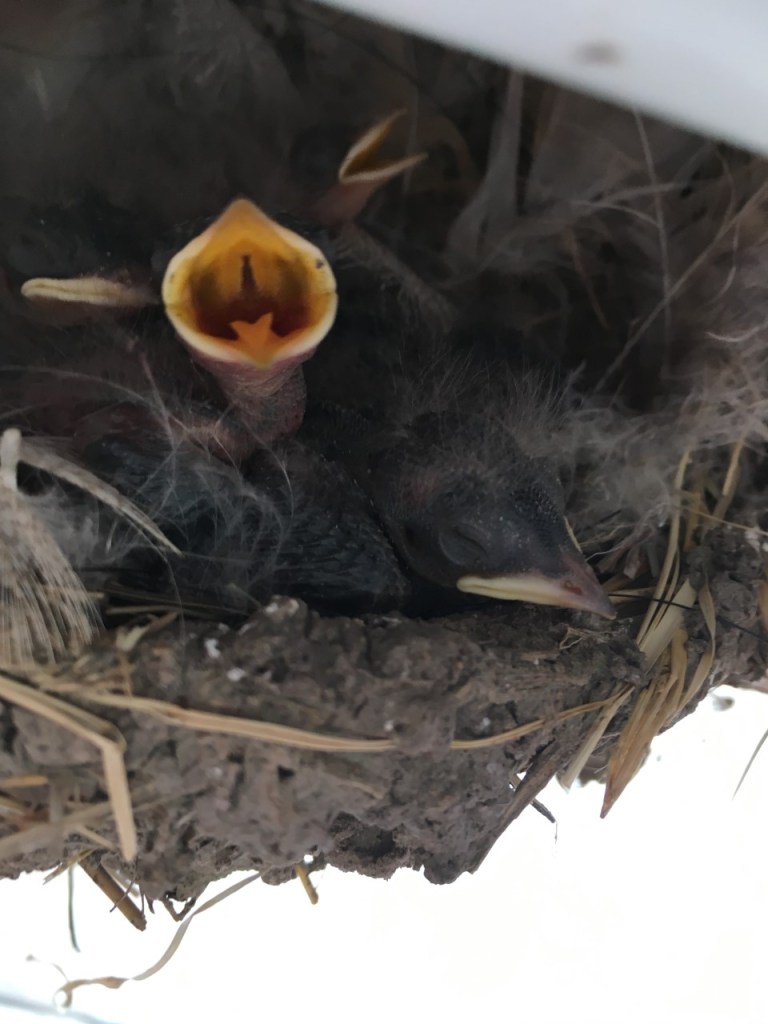
When the nest was completed this year, I was curious as to the size of their potential brood. Although the nest was too high for me to peek inside, with the help of a ladder I was able to reach high enough with my phone to take a photo.
Later, I took another photo after the birds had hatched. One of the hatchlings was obviously prepared just in case a bug happened to drop out of my phone.
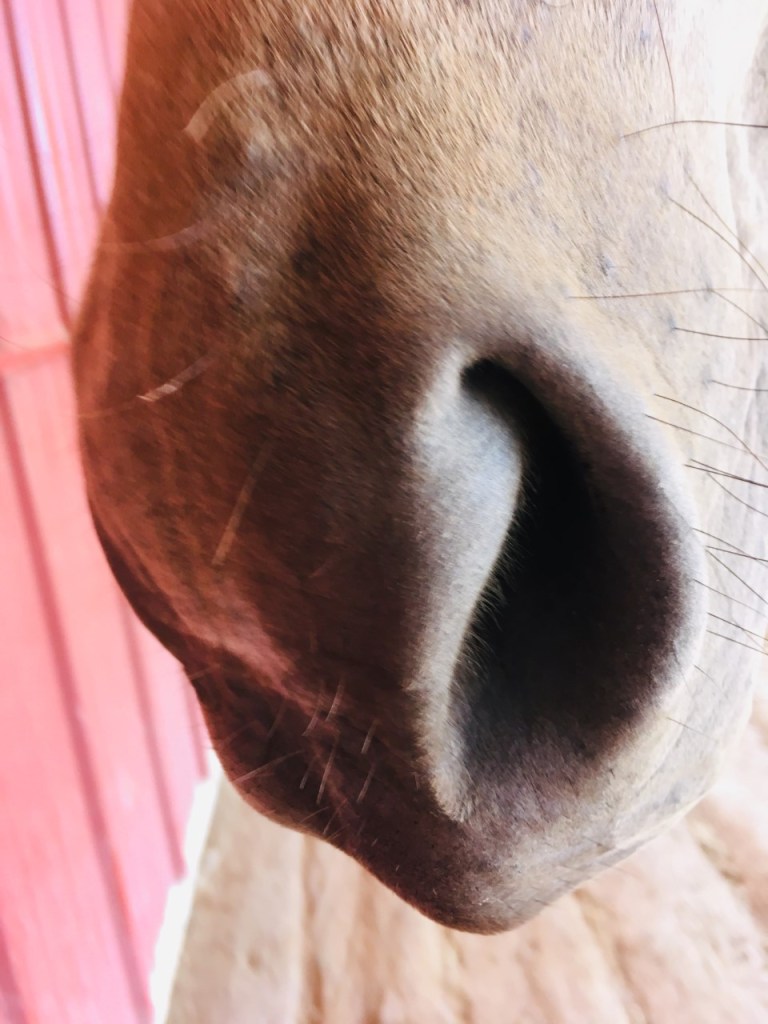
Here’s one more photo of the hatchlings in their nest:
Oops. Sorry. False alarm. That was BJ checking out my phone.
Let’s try that again:
The babies are out of their nest now and flying with their parents. When fall arrives, and the birds migrate to South America for the winter, I will remove the nest and wash the mud off of the light fixture. I want no obstructions to the light when I do my chores during the dark winter mornings and evenings.
Now that the swallows have raised two consecutive broods successfully in our loafing shed, I am certain that they will return again next year to that same spot in our barn.
I look forward to it.
(Swallows were a regular summer fixture in the barn of my youth.)
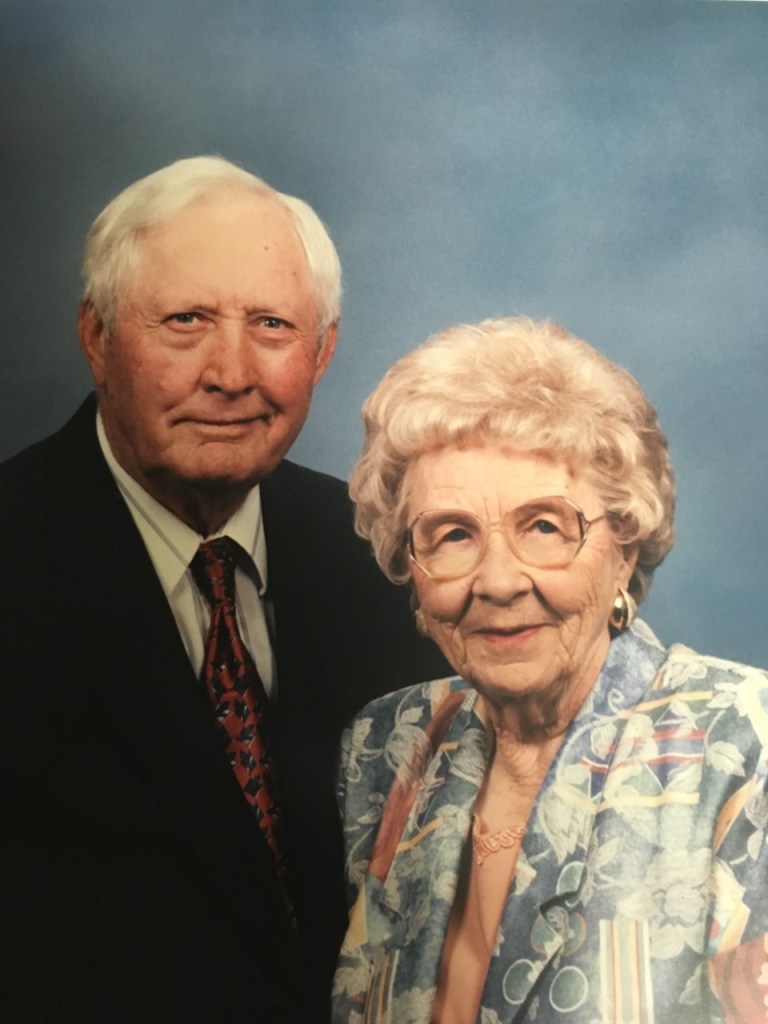
I think about my parents a lot in August. It’s not that I don’t think about them other times of the year, but I am particularly contemplative in August. My father died August 12, 1998 at age 84 and my mother died August 8, 2011 at age 96. So, August just naturally lends itself to remembering and reflecting.
Everything I know about farming I learned from my parents. From my dad I learned about livestock, machinery and crops. From my mom I learned about chickens, gardening and food preparation. But I would be doing my parents a huge disservice if I limited my comments to those things that I could have just as easily learned from a textbook, or in these days, the internet.
It was my parents that taught me about honesty, integrity, and the value of hard work. And it was also from my parents that I learned about gratitude. How an ungrateful heart is an unhappy heart. That true compassion and willing sacrifice for others stems from gratitude for one’s own blessings.
You won’t find that on Wikipedia.
Our parents didn’t teach my siblings and me about gratitude by setting us down each evening and lecturing us about it. Although, truth be told, I do recall hearing, on more than one occasion, my mother quickly squelching our various complaints with “You know, it could be worse!” And then she proceeded to inform us how, exactly, our situation could indeed be worse.
Mostly, however, they used a more subtle approach – teaching through example. For instance, I learned to appreciate each and every meal set before me by observing my dad savor every mouthful of what he lovingly referred to as “mom’s good cooking”, no matter how hurried or simple the meal had been. It was only later in my life when I learned from my mother that there were many nights during my father’s childhood when he and his siblings went to bed hungry. Without even knowing it, he taught me to be grateful that not once during my childhood or since – not once – did I ever go to bed hungry.
From my mother, I learned to appreciate each and every family member, even when I become irritated and exasperated with them. (Which is roughly as often as they become irritated and exasperated with me. I have never claimed to be a saint.) My mother had a cool head and displayed emotional restraint in even the most trying of times, and it is probably for this reason that I remember so vividly her silent tears as she buried her mother and only sister. After that, since her father had died when she was twelve, her only remaining immediate family member was an older half-brother. So now, even if I have a disagreement with one of my sisters, I am filled with gratitude that I even have a sister with whom I can disagree.
Several days before my mother passed away, we spoke about her impending death. Mom had, with full cognitive function, refused additional medical treatment that could have increased the quantity, but not the quality, of the time she had left.
I asked her, “Are you scared?”
“Oh, no!” she replied happily. “I know God loves me or he wouldn’t have given me such a good life!”
At the time, I just smiled and nodded in complete agreement. It was only later that I thought more about her “good life.”
After her father died, her mother single-handedly used a horse-drawn plow in the fields by day, and a sewing machine by night to feed and clothe her children.
Then the Depression hit. And the Dust Bowl.
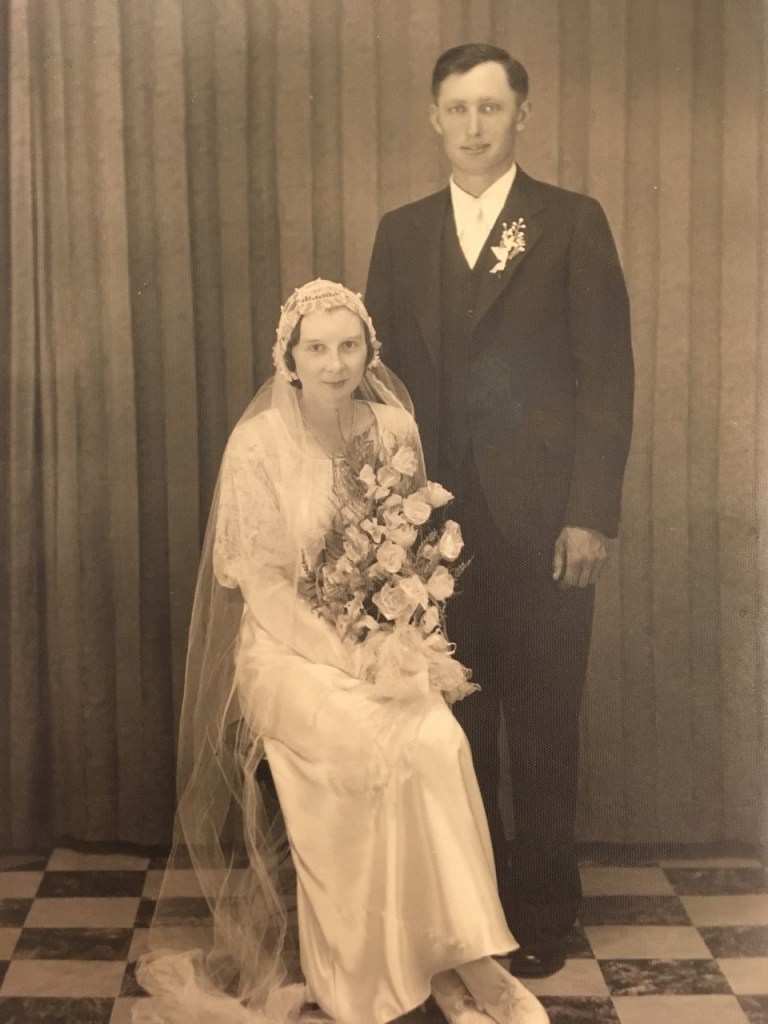
When she wed my father in 1934, they had only their meager wedding gifts with which to start a new life. Five years and four sons later, they still lived on a rented farm, saving every spare penny towards a down payment to someday purchase their own place.
“Someday” finally came fifteen years into their marriage, during which time they sent off relatives and friends to World War II and spent a year nursing a bedridden son stricken with polio.
By the time Mom died, she had buried her husband of 64 years, three sons and four grandchildren, some of them through tragic circumstances.
Any one of these heartbreaks could have turned the stoutest of souls bitter.
But it was not her heartbreaks upon which my mom dwelt in her last hours. She chose instead to be grateful for her life’s blessings. And there had been plenty of those as well.
Now, when I think of my parents, I realize that they are still teaching me life lessons, like gratitude. I wish I could tell them that.
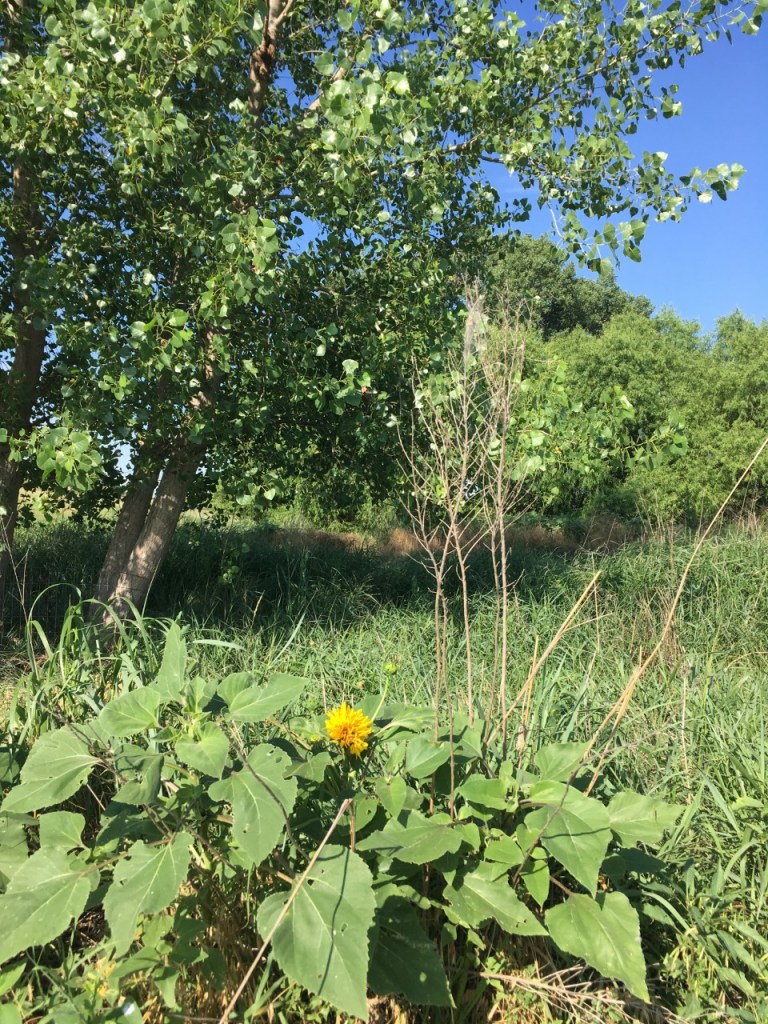
Most people are well aware that Kansas is nicknamed “The Sunflower State”. With good reason. Various varieties of sunflower are found in virtually all parts of the state, growing wild in pastures, and along roadsides and creeks. Cheery, bright yellow heads follow the movement of the sun for weeks in late summer and early fall, and herald the arrival of a new season filled with cooler, milder temperatures.
Most non-Kansans would not be aware, however, of the fact that the Cottonwood is the state tree of Kansas. In this photo, the sunflower may take center-stage, but it is the cottonwood in the background that shades the emerging flower in the heat of a summer afternoon.
It was for this very reason that the Kansas Legislature, in 1937, proclaimed it as the state tree by saying: “The cottonwood tree can rightfully be called ‘the pioneer tree of Kansas.’”
Imagine you are a pioneer, crossing the rolling prairie grasslands of western Kansas to claim a homestead. How do you choose the location of your new home? What do you look for? You look for a mighty cottonwood, rising majestically anywhere from 70 to 100 feet above the prairie landscape, easily visible from miles away. Not only does the cottonwood supply shade and windbreak in the often-brutal heat of summer, but it signals something even more precious – water. The cottonwood tree requires adequate moisture in order to grow naturally. A healthy cottonwood tree has discovered and tapped into a water source that can also be used to supply the needs of a budding farmstead.
The cottonwood tree was a symbol of new life for the pioneer.
The cottonwood tree can grow as much as eight feet per year and reaches full maturity in about forty years. But it can live as much as 100 years or more after its initial growth spurt.
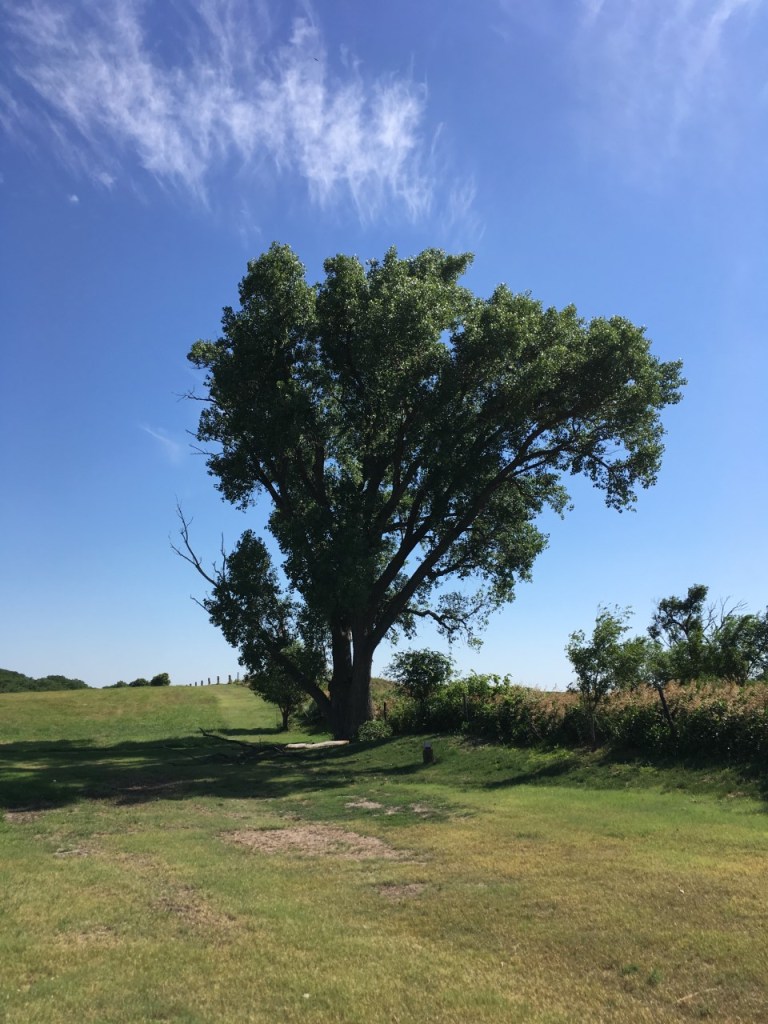
That’s why I love this giant cottonwood that lives near the creek on our farm.
It is a fully mature tree, and hasn’t changed in size for the almost-quarter century that we have owned the land. It’s hard to know exactly when it was a seedling, when it first took root, but my guess is that it was already a large tree when my father was a young boy swimming in the creek with his brothers. In fact, it could very possibly have already taken root when my great-grandfather first purchased the land in 1900. There are several young, developing cottonwood trees growing along our creek now, but this tree is the only still-living fully mature cottonwood tree on our farm, and I consider it our family tree.
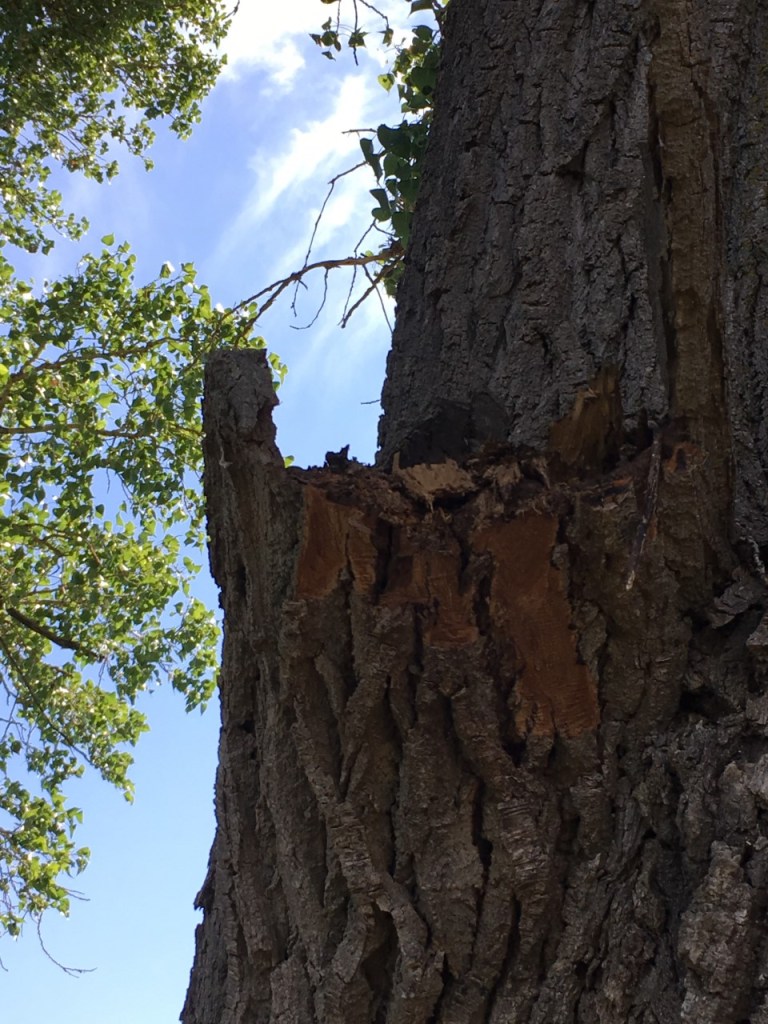
That is why I felt a tinge of sadness when I discovered the fallen branch one morning during a walk with my dogs.
Danny and I both knew the branch had been dead for some time. It had not shown any sign of life for several years. But it was a long, heavy branch and connected to the trunk high up on the tree. We thought it might be dangerous to remove the branch, so we agreed to let nature take its course. It would fall when it was ready to go.
But the tree itself still survives. And good will come out of the fallen branch. The jagged remains left on the trunk will make an excellent nesting area for the native birds.
And the branch itself will benefit us. Danny cut it into firewood that will supply much-appreciated warmth when the harsh north winds howl this coming winter.
Turns out that our “pioneer tree”, our “family tree”, is also our “giving tree.”
(Cottonwood tree leaves turn a shimmery, golden yellow in late fall. Check out the October chapter in my second book, Another Year on the Family Farm.)
I can still see my father rushing into the kitchen, exclaiming those words to my mother as she stood in front of the sink washing the breakfast dishes. There was such urgency in his tone. It meant that everything else on the farm now took a backseat to harvest.
As harvest drew near, as the fields transformed from green to gold, as the heads filled with kernels began to droop under the weight of their precious cargo, Daddy checked the fields daily. He waded into the interior of the field of waist-high wheat, because he knew the edges ripened first. He picked a few heads and squeezed out the kernels with his fingers. He popped a handful into his mouth and chewed. If the kernels were still soft enough to chew into a gummy, pasty blob, the wheat wasn’t ready. But if they were dry and hard and crunchy, it was time.
The weeks leading up to harvest were occupied with servicing his combine and truck, the only equipment he needed. He greased gears, changed oil, checked tires, replaced worn parts and cleaned his truck bed, which he also used to haul cattle. Then he waited, filled with anticipation and anxiety.
I remember great harvests after which my mother could afford to replace the worn living room sofa. And I remember somber harvests when Daddy announced at the breakfast table that the thunderstorm the previous night had destroyed two thirds of the crop.
So much depended on that harvest.
As a child, I loved harvest. Our normally quiet farmstead was filled with activity – Mama busy cooking, my sisters hauling meals to my dad and brothers in the fields, uncles visiting to help out and give my dad a break, cousins to play with.
As a teen, I still loved harvest, even though it now meant work, not play. But it was interesting work. It was beneficial work. It was family work, and I was part of the family.
Nowadays, harvest for me is different. I still love the sight of the “amber waves of grain”. I will never stop loving that. But I no longer play with my cousins in the wheat truck. I no longer haul the wheat to the elevator and eat fried chicken in the fields. We rent out our cropland, and it is the renters who do that.
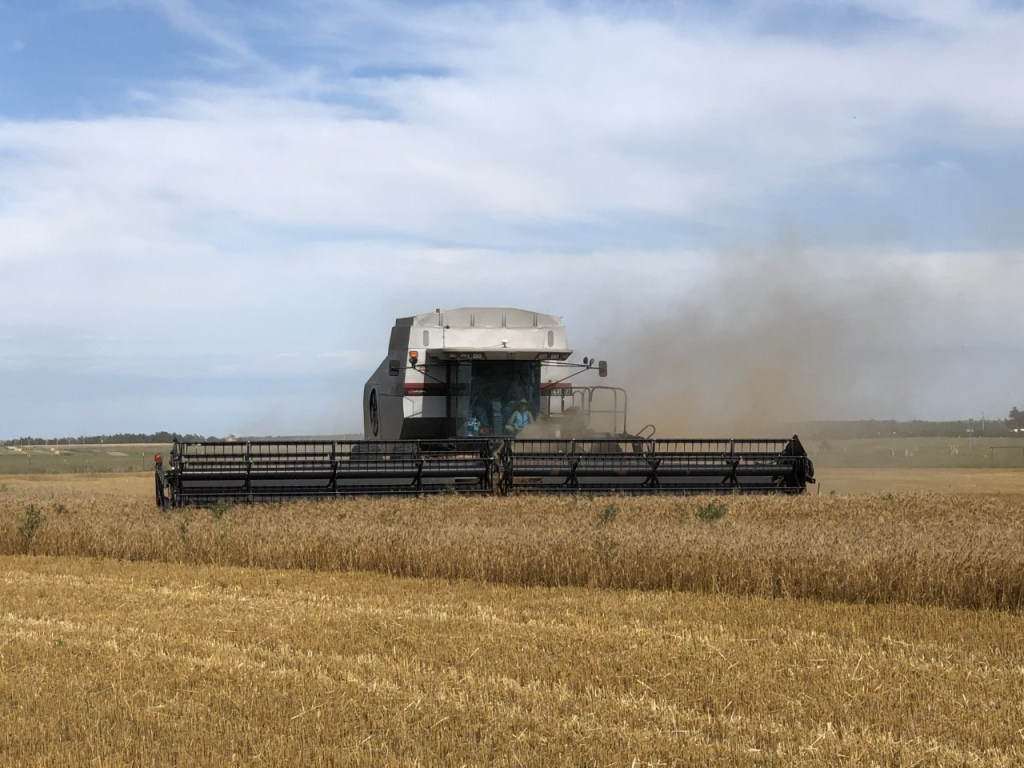
Since our move back to the farm, harvest commences for me with a casual text from Danny instead of an urgent rush into our kitchen. His text will simply let me know that the harvesters are moving onto our field. From our front porch, I watch as multiple state-of-the-art machines with air conditioning and GPS devour the wheat in giant swaths. Sometimes, if my own work for the day is done, I’ll sit in my porch rocker, observing, as I sip a glass of merlot. There are no harvest tasks for me anymore.
As I slowly rock, I can’t help but wonder what my dad would think if he could see these metal monsters clean up in a few hours the same field that used to take him a day and a half. But, I guess, that’s progress. I take a sip of wine. And I sadly realize that harvest, for me, has lost its magic.
Until this year. Until I got the chance to see harvest again through the eyes of a child.
Our son, his wife, and four children visited our farm the weekend following the Fourth of July holiday. They came from Phoenix to see family, and let the kids experience a few days of farm life. They didn’t come for the wheat harvest. That turned out to be an unexpected bonus.
Danny and I both agree that in all our years, we don’t ever recall a wheat harvest in our area that wasn’t completed by the Fourth of July. But this year, due to the wet, cool spring we had, many fields were not yet ripe until after the holiday. The wheat on our own land had been cut several days before our son and family arrived. But Danny was determined to give our grandchildren the opportunity to witness a wheat field being harvested.
He called our tenant farmer and asked if he still had fields to cut. It turned out that they had not yet cut their own. “Would it be okay if the grandkids got a combine ride?” Danny asked.
“Absolutely!” was the response.
The 8-year-old and 10-year-old granddaughters put on their boots and cowboy hats, and along with our son, drove with Danny and I to the field. We watched from our vehicle as the massive machine made its way around the field towards us. When Travis, the driver, saw us, he stopped, got out of his cab, and welcomed us onto the field.
Danny and our son stayed in our vehicle while our two granddaughters and I climbed the ladder into the giant cab. There was room for all of us with the 8-year-old on my lap and the 10-year-old sitting cross-legged on the floor of the cab, directly behind the top-to-bottom glass windshield. She had an unobstructed view of the entire process.
During our ride, the 8-year-old constantly asked Travis all sorts of questions that he skillfully answered to her complete satisfaction. Meanwhile however, the 10-year-old was silent, totally mesmerized by the whirring blades of the header, the rapidly oscillating sickle, and the spiraling auger feeding the cut stalks into the belly of the beast.
I touched her shoulder. “What do you think of all this?” I asked.
Her face beamed as she turned to smile at me. “So cool!” she exclaimed.
In my second blog, It’s Springtime on the Farm! I mentioned that I had planted my beet seeds. I don’t have a huge garden, but there are several things that I plant every year because I simply cannot live without them, and cannot tolerate the inferiority of the purchased product. Beets are one of those. I love beets. I could eat beets every day. I could eat an entire pint jar of my beets at one sitting. My mouth waters and my heart rejoices when I see my canned beets stacked neatly on my pantry shelf. I am a beetaholic.
But I am also a beet snob. I have a discriminating palate. It has to be my own tender beets, nurtured by my own hand, nourished with our own horses’ manure, and canned with my mother’s recipe. Beets in a salad bar? No thanks. I would rather drink boxed wine.
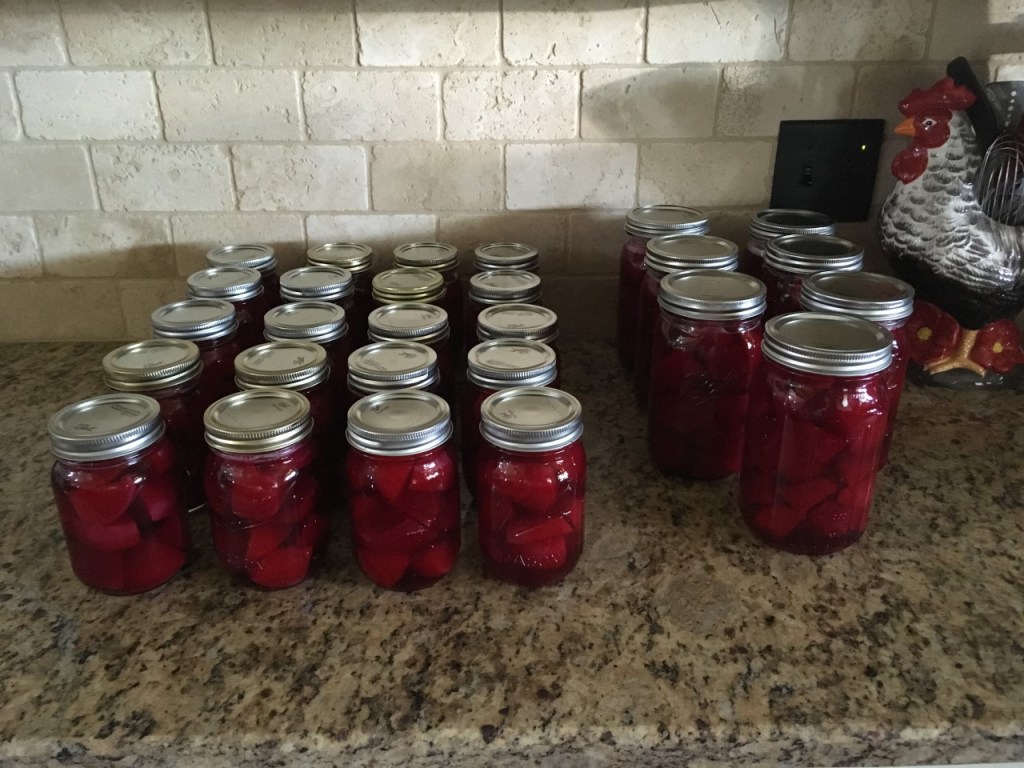
So, it was extremely satisfying this past week when, after a long, back-breaking day spent in my garden, then in front of the kitchen sink, and lastly over a hot stove, I could say, “My beets are canned.”
I really don’t mind those long hours. It gives me time to think. One of the things I thought about was how food preservation has changed through the generations. My preserved beets are a luxury. In my grandparents’ day, canned foods were a necessity.
Have you ever stopped to think about what you would eat if there were no electricity? Out here on the Kansas prairie, electricity wasn’t commonplace until the 1940’s, and on some farms, the 1950’s. Towns might have been electrified, but electrifying the outlying, rural areas took much longer. What would you do if you had no refrigerator for your milk, or freezer for your hamburger?
Every farm at that time had dairy cows and chickens to supply their daily staples of milk and eggs. These were kept cool in kitchen ice boxes. Blocks of ice were cut from creeks and ponds during winter, insulated with straw, and stored in underground cellars for use in ice boxes during the summer. Till the day she died in 2011, my mother referred to her refrigerator as “the ice box”.
Fruits and vegetables were canned and stored on shelves in the cellar. Pork and beef were butchered in late fall, after the weather turned cold. Most of the pork was smoked and hung on hooks in the cellar, and most of the beef was cut into cubes, boiled, placed in stoneware crocks where it sealed with its own congealed fat, and also stored in the cold cellar.
Transportation was provided by horses, and only late in the pre-electric era did cars and trucks appear. Roads were poor and often impassible after a heavy snow or rain. Because of this, there were no weekly trips to a supermarket. In fact, there were no supermarkets. If you expected to eat during the winter, you had better prepare for it the summer before.
As I scrubbed my beets at the kitchen sink, I thought about the old days, and what a tragedy it would be if they were forgotten. I want to do whatever I can to preserve those memories.
In earlier blogs, I have mentioned that I come from a large family. Danny and I are very fortunate to be invited to the birthday parties of my great nieces and nephews, the grandchildren of one of my sisters. These parties are always joyous family gatherings, and everyone has a wonderful time. For years however, I struggled with ideas for birthday gifts for these adorable children. A Walmart gift card seemed lazy and highly inadequate.
After our move back to the farm, it occurred to me that I had something I could give to them that no one else could. A farm experience! Since then, I have given, as a birthday gift, a handmade gift certificate for a 3-day, 2-night stay at our farm. The kids love it!!!
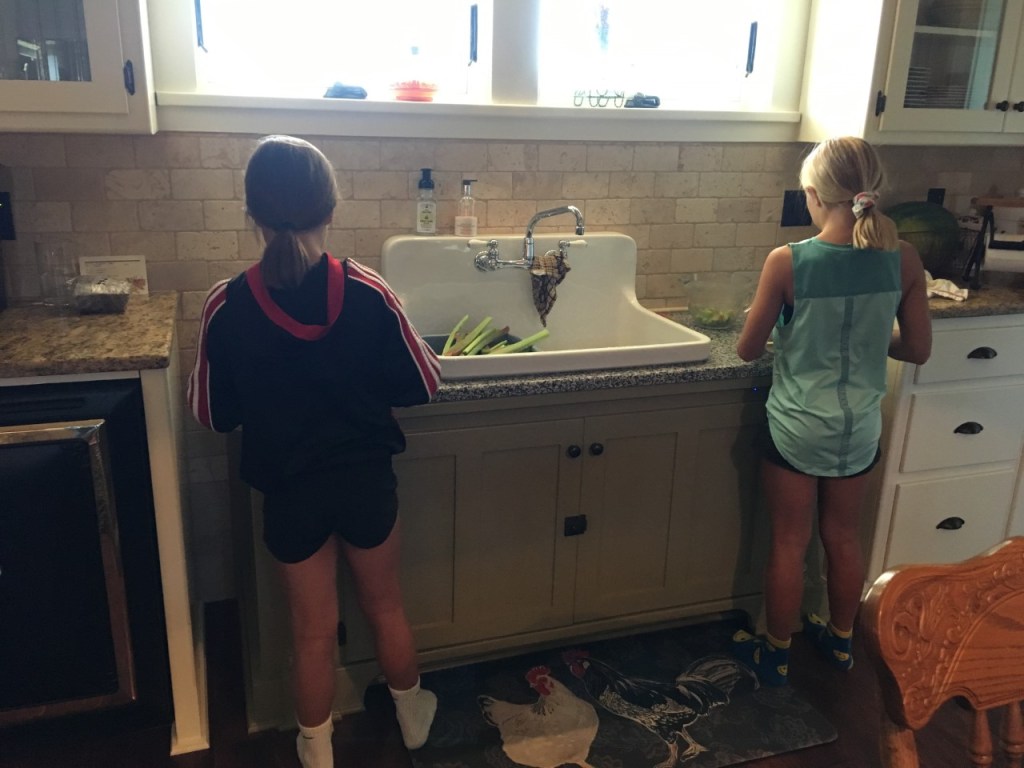
I mention this because a couple of weeks ago, two of the cousins came at the same time. During their stay, they helped me preserve my rhubarb jam. (The first photo shows my uncut rhubarb.)
They clipped the leaves off the stalks…
And they sliced the stalks before cooking.
After I had filled the jars with the cooked jam, they helped place the lids and rings on the jars. As a thank you for their great help, I sent a jar of jam home with each of the girls.
Every year, when we take the girls back home, their parents always thank us for giving their children such a wonderful opportunity. The children give us warm hugs and a heartfelt “thank you” for the great time they had.
But you want to know a secret? We get as much enjoyment from sharing our farm as they do. Because in doing so, we preserve more than food. We preserve precious farm memories.
For all of us.
(Each of my books has been written with this purpose in mind: to help preserve farm memories for those who experienced farm life themselves, and to share farm memories with those who didn’t.)
To the urban majority, that statement may seem as mundane as, let’s say, “I bought groceries today” or “I did a load of laundry.”
But farmers and ranchers who depend on that hay to feed and nourish their beloved animals for an entire year get it. Plus, this was no ordinary hay crop. Let me put this year’s hay into perspective for you: Imagine that you have secretly hoped for a particular birthday gift, but realistically do not expect it, because it’s just asking too much. Then, when you open the present, there it is!
This year’s hay crop was like that.
Believe me, it isn’t always this good. We’ve had years when we got plenty of hay, but the quality was poor – too tough and stemmy, or too seedy, and the horses find it unpalatable. Then we’ve had years with great quality hay – sweet, leafy and the horses love it – but there just isn’t enough of it.
Last year’s crop was like that. We knew when we stored our bales in the barn last summer that we ran the risk of running short come spring, so we budgeted our daily feeding through the winter very carefully. But we never expected the cold, snowy winter we got in 2018/19!
By early spring, 2019, given the rate of consumption, we knew we would run out of bales before the pasture grass was edible. We tried purchasing bales from area farmers, but they were running short just like we were. So, to stretch out the hay we had, I cut back on my horses’ daily allotment, and began supplementing with a mixture of hay pellets, corn and oats that I purchased from Orscheln. It was expensive, but what other choice did I have? By the time I finally turned my horses out to pasture in late spring, I had one bale left.
The one positive effect of the heavy winter snow and spring rains was that they produced what we knew would be a record-setting hay crop this summer – if we could just get it off the field at the right time.
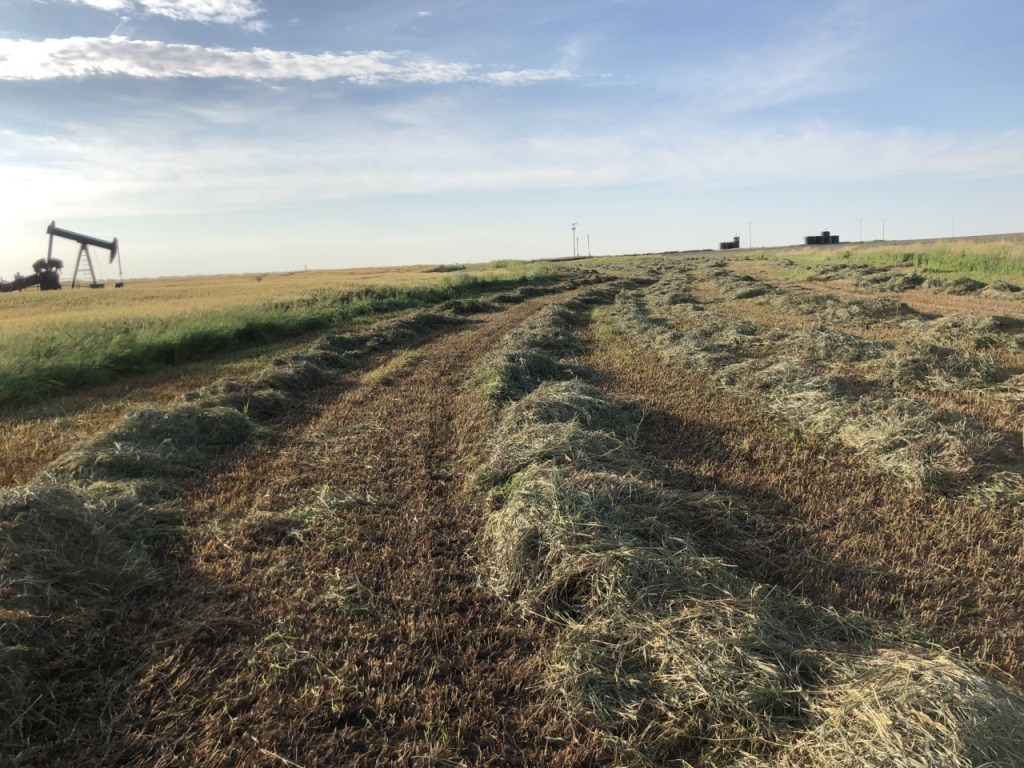
We need three days to get our hay crop off the field and into the barn: one day to swath it, one day to rake it, and one day to bale it and haul it. That may sound like no big deal, but finding three consecutive days in Kansas with low probability of precipitation at the same time that the bromegrass is at peak nutritional value and that don’t interfere with wheat harvest, is no easy task.
I began intently listening to the weather radio two weeks before we cut the hay. Several times I thought I found a 3-day window only to have rain chances increase to 40% or more as the days approached. Too risky, we agreed. Even a light shower increases the odds of moldy hay, and decreases the nutritional value because of added drying time.
Meanwhile, the local farmer who agreed to do our swathing and baling was on stand-by, along with some fit, young men who could easily toss a 60-pound bale. They all waited for our call.
Finally, we found our window! Three dry, sunny days with only a 20% chance of overnight rain while the hay was at peak quality. And the local wheat was still too green to cut. Bingo!
As it turned out, it didn’t rain and the bales were perfect. However, on the evening we were to haul our pristine bales off the field, two of our strong, young men became unavailable! We scrambled, and found one replacement. It would have to be enough. Our team of five would now have to do the work of six. Overnight rain chances had increased again, and the hauling could not be postponed.
We knew that our replacement had already put in a long day of hard, physical labor, but he agreed to help us that evening anyway. It’s what we do. We help our neighbors in need even when it’s inconvenient.
Luckily, the weather that evening was cool and mild, saving the workers from the exhaustion that accompanies triple-digit temperatures or 40-mile-per-hour wind gusts. Just one more blessing for which to be grateful.
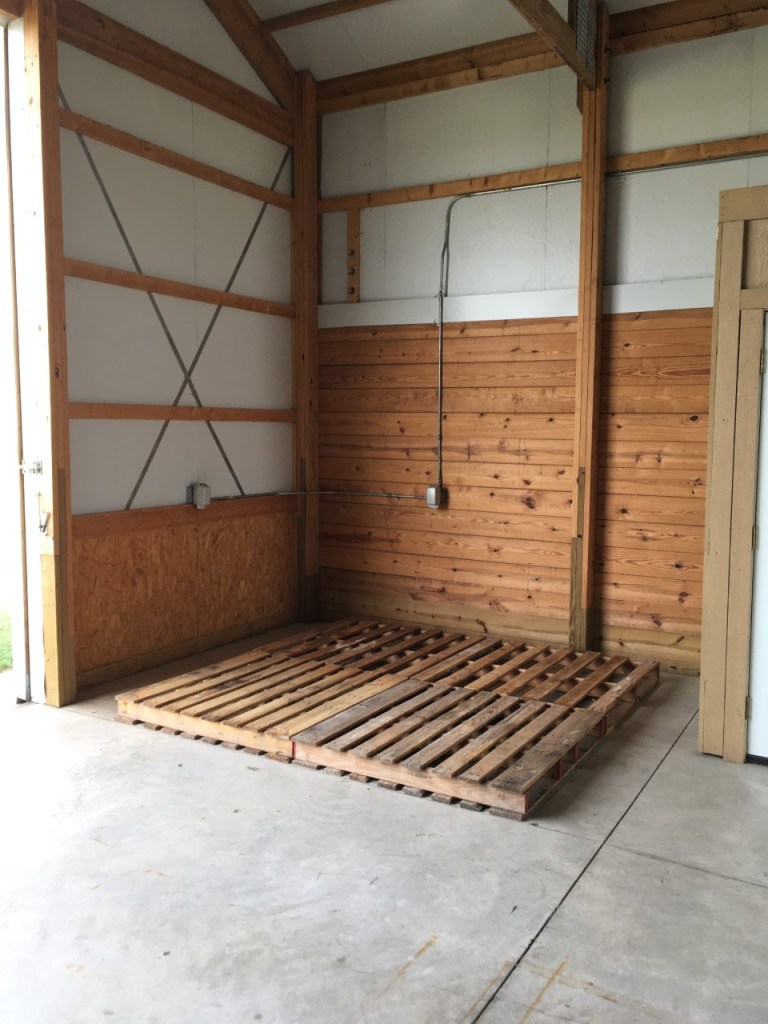
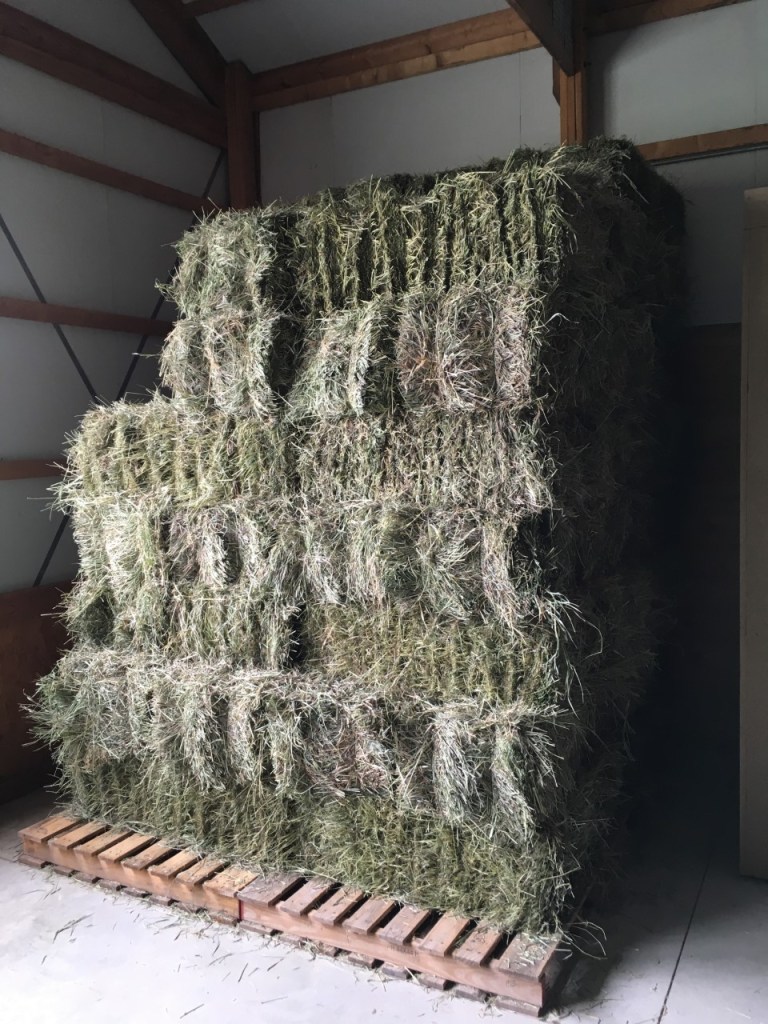
Farm events like this can be compared to an Amish barn-raising. Yes, there’s hard work, but there’s also a social aspect and shared pride in a job well-done. After the bales had been neatly stacked in our barn, we all sat around eating pizza, drinking pop, and sharing jokes and fish stories.
My favorite after-bale-hauling memory occurred four or five years ago. It had been a very hot day, so we started later than usual to allow the temperatures to cool a bit. It was almost dark by the time we finished. We all sat on the concrete driveway pad outside the barn, drinking our pop and beer and waiting for the pizza to arrive.
The overhead barn light was attracting all sorts of flying bugs. A toad hopped out of my garden onto the driveway next to us. Randy grabbed a buzzing June bug with his hand and asked me, “Have you ever fed a toad?”
“No, never,” I replied.
For the record, I hate June bugs. They are noisy, nasty things that swarm around your head, land in your hair, cling to your clothes, and fly down your shirt. “Watch this,” Randy said as he tossed the June bug towards the fat, motionless toad.
I watched the arc of the tossed June bug as it approached the toad, and then…it was gone! Just…gone! It all happened so fast that I never even saw the toad move!
I think it was in that instant when I fell in love with toads.
“Let me try!” I said as I grabbed one of the disgusting June bugs. Every tired, sweaty bale hauler that evening was completely and happily entertained the entire time until the pizza arrived.
This year, the weather forecasters had been right about the rain. That night, hours after our bales had been safely stored in the barn, it rained. But Danny and I slept so soundly that we never even heard it.
Because our hay is in the barn.
(I first learned to drive at age eleven while hauling bales for my dad. Read about it in the June chapter of my second book, Another Year on the Family Farm.)
Two weeks ago, my blog took on a very somber tone when I described BJ’s bout with colic. At the end of the blog, I listed the ages of our farm animals and stated that, with aging pets, loss is an inevitable reality.
Mere days after I wrote that blog, Danny and I said goodbye to Sherlock, our gray tabby, in our vet’s office.
We knew his health had been failing, and the day before we took him in, I saw evidence that his condition was deteriorating very rapidly. Plus, I suspected that he was possibly in pain. We waited a day to see if he would recover, and when he did not, we took him to our vet to euthanize. We know we did the right thing, and we will miss him, but we will treasure our amazing memories of Sherlock, our “Tom Hanks” cat.
Danny and I both agreed that we needed another cat. The perfect opportunity arose when two of our granddaughters, cousins to each other, visited our farm recently. I first took them shopping at Orscheln (my favorite store!) where I bought them each a pair of boots (one can hardly visit a farm without proper boots!), then it was on to the Humane Society to shop for a new cat.
Unfortunately, there were far too many from which to choose. As much as I wanted another cat, nothing would have pleased me more than to have them tell me, “Oh, so sorry! All of our cats have already been adopted!” That wasn’t the case.
I told the girls that I didn’t want a newly-weaned kitten. Instead, I wanted a youthful cat, but one old enough and smart enough to protect itself against wild animals should it wander into our pastures.
As we strolled down the aisle, looking into each cage, both girls were immediately intrigued by the same cat – a butterscotch yellow tabby with white socks. He was keenly aware of us, and appeared quite playful as he stuck his paw through the cage door.
“I want this one!” they both exclaimed.
I too, thought he was not only very pretty, but his personality seemed quite friendly and playful.
“Let me see what his name is,” I told them as I flipped over the card on his cage.
“Sherlock?!! Are you kidding me?!” I exclaimed.
There was another woman in the room with her daughter, also looking at the cats. She stared at me with obvious confusion at my reaction to his name.
I quickly explained. “We just recently lost a cat. His name was Sherlock.” She smiled and nodded in understanding.
I turned to my granddaughters. “Girls, I think it was meant to be.”
When Danny met him, he too fell in love with our newest family member, but hesitated at calling him “Sherlock”. I agreed. Somehow, we both felt that our other Sherlock, the one we buried, deserved that identity. Yet fathers and sons were given the same name all the time. How did they avoid confusion?
“Let’s call him Junior!” I told Danny.
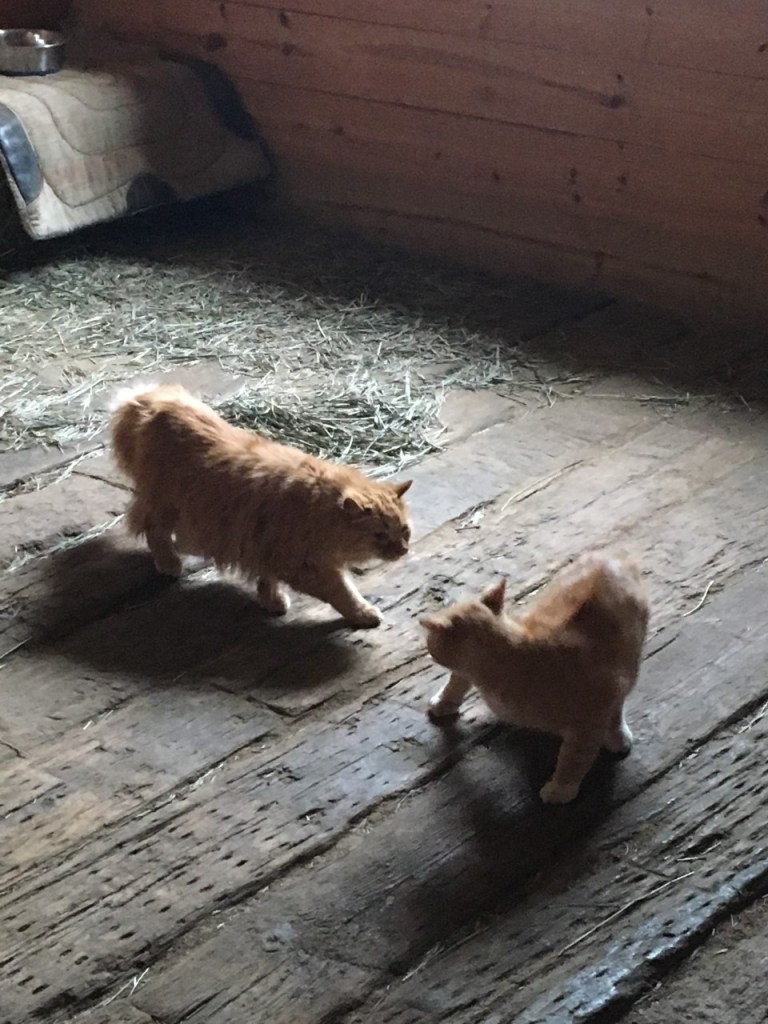
So, what kind of a cat will Junior be? This much I know: he is playful,
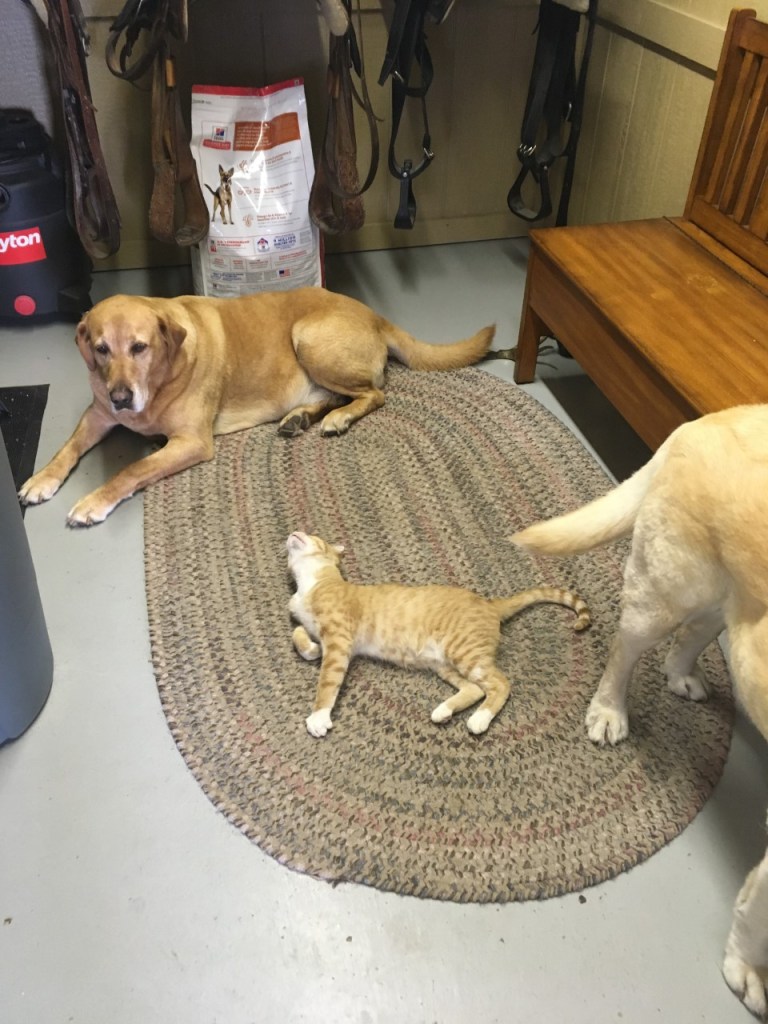
loves people, and the dogs, but is cautious around the horses. (That’s a good thing. I don’t want him stomped on.)
He has also shied away from Simba. (Who doesn’t?!)
As far as being a mouser, the jury is still out. He caught this mouse, played with it awhile…
Danny and I moved permanently to our farm in January, 2009. We sold our house in town, and totally committed ourselves to living the rest of our lives on the land that had been in my father’s family one full century, plus a quarter of another.
During our first two years, we lived in a small cabin while we built a larger, modern house. During that time, there were many memorable weather events: thunderstorms, blizzards, heat waves, and high winds. But there were also many sun-drenched days and star-studded nights that were so beautiful, we had to pinch our own arms to convince ourselves that we had not died and gone to heaven.
In a word, it was typical “Kansas”. And it was why we loved it.
We moved into our new home on the farm in November, 2010. Ironically, it was also in November, 2010 when our typical weather pattern changed.
That winter, we got no snow. The following spring of 2011, we got no rains. Or at least, not nearly enough. With no grass established around our newly built home, the prairie winds blew and swirled the bare dirt into every nook and cranny. Instead of using our snow shovel for its intended purpose, I used it to scoop dirt off our porches. We planted some shade trees that spring, but struggled to keep them alive. Their leaves wilted in the scorching summer sun. And still no rains.
Oh well. There’s always next year, everyone said.
But 2012 was even worse. Stories my mother had told me of the Dirty Thirties haunted me as I checked my horses’ water in 112-degree heat. Creeks and ponds had hard, cracked bottoms. Water wells dried up. Wheat fields had record low yields. Cropland was left unplanted because farmers needed rain before they could seed. Rains that never came. Cattlemen hauled water for their cattle daily and reduced herd numbers so they could survive on the sparse pasture grass. There were feature stories about grass fires in the newspapers and on the nightly news. No conversation between locals was complete without mention of the drought.
It was on everyone’s mind and affected everyone’s psyche. I taped my Prayer For Rain to the front of my refrigerator and recited it daily.
As much as I had wished for it, by 2014 I began to doubt our decision to move to our treasured family farm. Life in the country was just so hard with no rain!
Then on June 4, I visited my sister and brother-in-law in town to celebrate my brother-in-law’s birthday. When I began to complain, once again, about the drought, he stopped me.
“Mary Kay, it will rain again someday. You know it will. And today, you’re one day closer to the next big rain.”
I sat silent, absorbing his profound insight. I’m not sure why his words affected me so, but my spirit had been immediately lifted!
Little did I know that his words were also prophetic.
Within the week, we received over an inch of rain! Although certainly not a drought-buster, it was the first big rain we had received in far too many months. Farmers smiled again.
By the end of June, we had received over twelve inches of rain! That is almost half a year’s moisture in a typical year!
Of course, after four years of drought, the thirsty soil, trees and grasses greedily soaked it all in, so creeks were still not running. But then we got more rains in August! Finally, by the end of 2014, creeks and ponds held stored water for the upcoming winter, and it appeared that our drought was officially over. Things were back to normal.
Until this year.
Life is filled with cycles. Wait long enough, and even bell-bottom jeans come back in style.
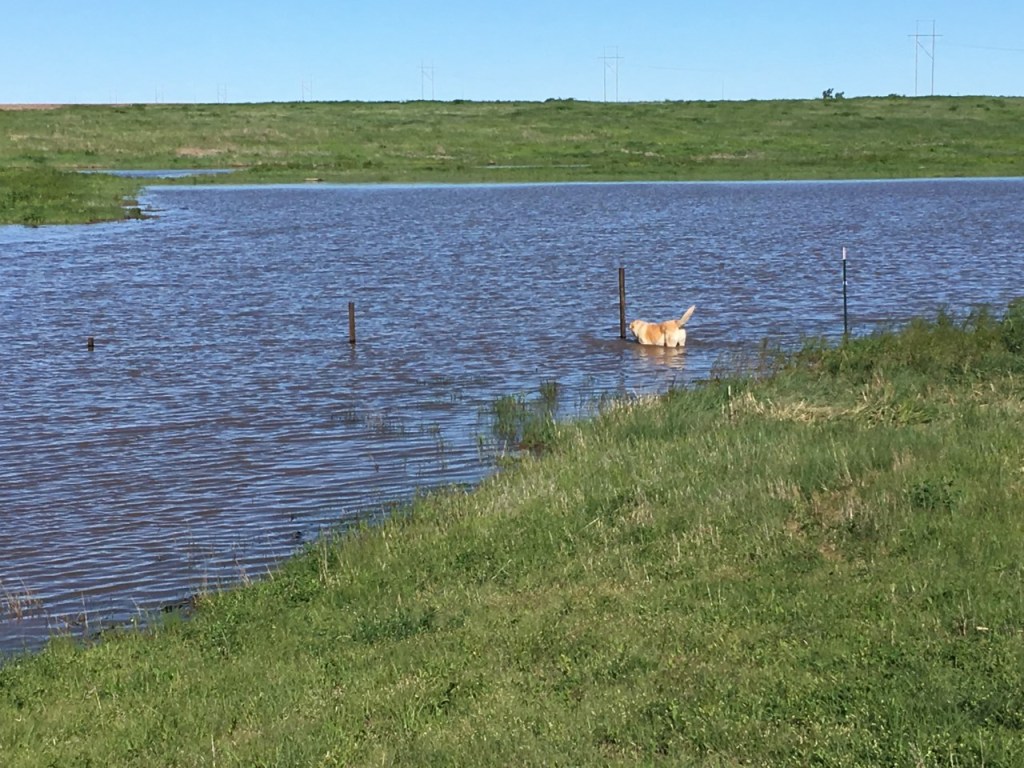
This past winter, we received more snow than we had in the previous decade. Snowmelt caused our creeks and ponds to spill out of their banks. But it didn’t end there. Our spring was also wetter than normal, and since Easter on April 21, we have had over fourteen inches of rain.
Now, flash flood warnings have replaced wildfire warnings. Instead of shoveling dirt, I pick up flood debris. Instead of watching their crops wither and die from lack of rain, farmers now watch their crops mold and rot in fields too wet to enter with machinery. Instead of hauling water, cattlemen search for calves washed away by flood waters.
And, for now, I no longer recite my daily Prayer For Rain.
But life will get back to normal again. I know it will. And today, I’m one day closer.
(Weather – blizzards, thunderstorms, even tornadoes – play a major role in many of my farm stories in all three of my books. One cannot live on a farm without being intrinsically affected by weather.)
If you’ve been reading my blog regularly – thank you. If the reason you read it is because you enjoy my sense of humor – thank you again. It is to you faithful readers, that I wish to apologize in advance. For there is no humor in today’s blog. There was simply none for me to find.
I could have lost BJ last week. BJ, my youngest horse, my corral clown, my hat-stealer. That BJ.
There is no single word that strikes fear in the heart of any horse owner more quickly than the word “colic”. To most people, that word conjures up images of crying infants and sleepy, distraught parents. To far too many horse owners, it means death.
When I was eighteen, my family lost a yearling to colic. Arapahoe was born to our mare Strawberry, who we had raised from a foal. Arapahoe was a member of our farm family, and we were all heartbroken.
Eleven years ago, Danny and I lost Pokey to colic. Pokey was a sweet-tempered pony loved by everyone who knew her. I still treasure the crayon-drawn sympathy cards sent by some of the young children who mourned her loss with me.
So, you see, my knowledge of colic is personal, and my fears are not unwarranted.
Unlike dogs, cats and humans, horses cannot vomit. When a dog or cat has an upset stomach, they can vomit and relieve their own discomfort. Since a horse cannot do that, the offending substance must pass through the entire intestinal tract in order to bring relief. If there is gaseous build-up along the way, or if the intestine becomes blocked, the situation can become very serious, very quickly. When a horse is experiencing colic, they have a tendency to roll and twist their bodies on the ground, trying to relieve their pain. Unfortunately, this can lead to the intestines twisting and closing off the offending material. When that happens, gas continues to build, creating more pain. If caught soon enough, emergency surgery can save the horse. If not, it inevitably leads to death.
It is imperative that a horse experiencing colic not be allowed to roll.
It was right about noon. I was washing my hands at the kitchen sink when I glanced out the window and saw all three of my horses grazing. Suddenly, BJ lifted his head and began trotting circles around the other two. At first, I thought he saw something – maybe a deer – that excited him. But the others kept grazing. Then he began running more erratically, kicking out behind him with his hind legs. Although his behavior was quite unusual, I still thought he was just being playful. It was only after I saw him turn his head and bite at his own sides, that I understood. He was in pain.
I immediately went outside and watched him more closely from the pasture fence. I had not called to him, but when he saw me, he immediately came running toward me. It was a very cool day, but as he ran past me, I could see that he had broken out in a sweat.
Suddenly he stopped, dropped to his front knees, and began to roll onto his side.
“No BJ!” I yelled as I shimmied through the rails of the pasture fence. As I ran towards him, waving my arms and yelling, “Get up! Get up!” he lifted his head off the ground to look at me. He got back up onto his feet as I approached him. I had no rope, nothing but my hands, but I hoped he would follow me to the barn. He did. I truly believe he knew I was trying to help him.
As we hurriedly walked together to the barn, I pulled out my cell phone and called my vet’s office. When the receptionist heard that BJ had colic, she understood the emergency and promised that a vet would leave immediately. It’s about a twenty-five-minute drive to our farm.
I put a halter and lead rope on BJ and we began to walk. Walk to help relieve symptoms, walk to keep his blood flowing and intestines working, walk to keep him from rolling.
By this time, both BB and Zip had responded to BJ’s predicament, and both came running to the barn as well. BB walked beside us, and periodically nickered softly to BJ. She did not interfere, but she also did not leave our sides. I truly believe that she, too, knew that I was trying to help BJ. Zip stood a distance away, but watched every move we made, also nickering periodically.
I could tell that BJ was in intense pain. He was sweating more profusely and his eyes were wide with terror. Several times, he attempted to drop to his knees, and I knew he wanted to roll. Somehow, I managed to keep him on his feet and walking. Several times, he bit at his sides, as if the monster attacking him and causing such pain could be crushed by rolling, or scared away by biting.
Twelve minutes had passed since my first phone call to the vet. I called again.
“Has he left yet?” I asked.
“Yes,” she reassured me. “He should be there very soon.” We kept walking.
About fifteen minutes later, I saw the vet’s pickup truck turn onto our farm’s driveway. I had walked BJ, with BB walking beside us, for the entire thirty minutes.
The vet gave BJ two shots, one to relax him, and one to aid his digestion. The effect was almost immediate. He stopped biting his sides. His sweating lessened. His eyes looked more normal. His muscles relaxed.
And then he pooped.
The vet stayed about twenty minutes longer, just to be sure that he would not relapse, but the crisis was over. At least it was for BJ.
For me, the repercussions lasted a bit longer. What if I hadn’t looked out the kitchen window when I did? What if I had gone to town to get groceries? What if…?
The reality is, when you open your heart to love, you also open it to the pain of loss. The two are inseparable. With three horses aged 20, 17 and 10, two dogs aged nine, two cats aged twelve, and two rabbits aged seven, there will be losses. And it will be painful.
But I would rather live a life filled with love and loss, than no love at all.
(There is a photo of Arapahoe with Strawberry in the July – The Filly chapter of my first book, A Year on the Family FarmandI talk about Pokey in the February chapter of my third book, The Return to the Family Farm.)













 Year on the Family Farm